
Most people think the California gold discovery happened in 1848 at Sutter’s Mill, far to the north. But the first authenticated gold find in the state took place six years earlier, just a short drive north of Burbank. That bit of local history is a good reminder that people in the San Fernando Valley have been digging up, trading and treasuring gold for a very long time.
The California Gold Discovery Story Begins in Placerita Canyon
On March 9, 1842, a rancher named Francisco López was out in Placerita Canyon, near present-day Newhall. As the story goes, López dozed off beneath an oak tree and dreamed he was floating on a pool of gold. When he woke up, he dug a few wild onions out of the ground and found tiny flecks of gold clinging to the roots. That moment is recognized as the first authenticated gold discovery in California, and the tree, known as the Oak of the Golden Dream, is a registered California Historical Landmark. You can read the official description on the California Office of Historic Preservation website.
The dream may be part folklore. Some accounts note that López had studied mineralogy and was probably searching for gold on purpose. Either way, he took his samples to Los Angeles, where their worth was confirmed, and he later put his claim in writing in a petition that is now kept in the National Archives. That paperwork is a big reason his find counts as the first documented gold discovery in California.
A Gold Rush Before the Gold Rush
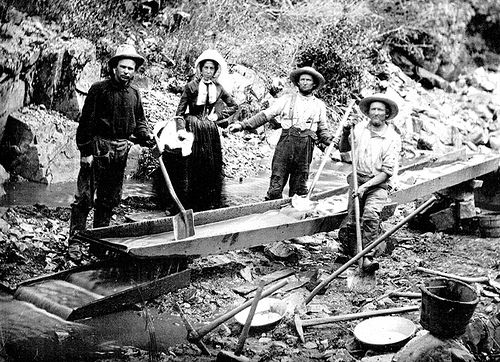
López’s find set off California’s first small gold rush. An estimated 2,000 people, many of them experienced miners from Sonora, Mexico, came to work the canyon with pans, sluices and dry-washing methods. One history of California reports that roughly 2,000 ounces of gold had come out of the area by 1843. At today’s prices, that much gold would be worth more than $8 million.
Some of that gold traveled a long way. A Los Angeles merchant named Abel Stearns shipped part of it around Cape Horn to the East Coast in 1843, where it was most likely melted down and turned into coins. The mining eventually faded, and when James Marshall spotted gold at Sutter’s Mill in January 1848, the world’s attention shifted north.
Southern California has kept surprising people ever since. In 1977, a prospector with a metal detector found the Mojave Nugget near Randsburg. It weighs 156 troy ounces and now belongs to the Natural History Museum of Los Angeles County. At today’s prices, the gold in that single nugget would be worth roughly $650,000. The lesson hasn’t changed since 1842: gold holds its value, and it has a habit of turning up in unexpected places.
Watch the California Gold Rush Story
This short history film covers the California gold rush and the wave of people it drew to the state.
What Gold Is Worth Today
Gold is still doing what it did in 1842: holding its value. On October 9, 2026, spot gold traded at about $4,200 per troy ounce, and silver was trading near $60 per ounce. Gold has pulled back from the peaks above $5,000 it reached in February, but it remains far higher than it was just a few years ago. Prices change every day, so treat any number you see online as a snapshot.
Here is what that means for everyday items. A 10-gram 14K gold chain contains about 5.8 grams of pure gold. At roughly $135 per gram, that is about $780 worth of gold, before any dealer margin. A broken bracelet, a single earring or a worn-out wedding band can add up quickly. Coins can be worth even more, because collectors often pay a premium over the metal value for rare dates and good condition.
Gold Hiding in Valley Homes
You do not need an oak tree or a gold pan to find gold in Burbank. For many local families, the gold is already sitting in a dresser drawer. Here is what to look for:
- Broken, tangled or mismatched chains, bracelets and earrings
- Wedding bands, class rings and other old jewelry, even if damaged
- Gold coins, plus U.S. dimes, quarters and half dollars dated 1964 or earlier, which are 90% silver
- Sterling silver flatware, tea sets and platinum jewelry
- Gold or silver bars and rounds tucked away in a safe or closet
Keep any coins in their original envelopes or albums, and do not clean them. Polishing can reduce what a collector will pay.
Sell Gold in Burbank Instead of Visiting a Pawn Shop
If you are ready to sell, choose a buyer who knows the difference between scrap and a collectible. Generic pawn shops often treat everything as scrap and make low offers. Paul Albanian and Associates LLC has been buying precious metals, coins and fine jewelry in the San Fernando Valley, right here in Burbank, for more than 30 years. Your items are examined carefully, the value is explained clearly and the offer is fair, so you can make some extra money from things you no longer use.
This is especially helpful during an estate sale. If your family is clearing out a parent’s home, set aside the fine jewelry, precious metals and coins before the sale begins. Those items should not go out at garage-sale prices. Selling them to a trusted local gold dealer is a simple way to turn a loved one’s belongings into cash, without listing items online or meeting strangers.
Francisco López learned in 1842 that something valuable can be hiding in plain sight. Today, a coin dealer Burbank families trust, and a precious metal dealer Burbank customers rely on, can help you find out what is hiding in your own home. Bring in your gold, silver, platinum, coins or jewelry and learn what they are worth.